Nearly every mistake a beginner makes has the same shape: one feature matched, so the identification felt settled. Colour is the usual culprit, because it is the first thing you see and the thing that varies most with age, weather and light.
Experienced foragers work through a sequence instead, and they treat a single matching feature as the beginning of the question rather than the answer.
The sequence worth following
- 1Habitat and substrate: what is it growing on or near, and which trees are around it? This narrows the field more than colour ever will.
- 2The underside: gills, pores or spines — and if gills, how they attach to the stem.
- 3The stem: is there a ring, a bulb, a sheath at the base? Dig gently rather than snapping it off, because the base carries decisive features.
- 4Flesh: does it change colour when cut, and does it exude anything?
- 5Smell, and only smell — never taste as an identification step.
- 6Spore print, when the species groups you are considering are separated by spore colour.
Why one feature is never enough
Species that look alike often differ in exactly one or two characteristics, and those are rarely the conspicuous ones. That is precisely why an identification built on a single match is unreliable — the feature you matched may be the one the species share.
The practical rule is to be able to state several independent features that agree, and to name what the mushroom could be confused with. If you cannot name a confusion species, you have not finished looking.
Photographing so the photo is useful
- Take the cap from above, the underside, and the whole stem including the base.
- Include the surroundings in one shot — habitat is diagnostic information.
- Add something for scale.
- Photograph in natural light rather than with flash, which distorts colour.
- Take the photos in place, before you carry the mushroom home in a bag.

Using the app in the field
- 1
Photograph before picking
Cap, underside, stem base and surroundings — the app keeps them with the find.
- 2
Work through the guide
One feature at a time, rather than jumping to a name.
- 3
Compare with the library
Look at the candidate species and at what they are confused with.
- 4
Save it either way
Even an unidentified find is worth logging with date and position for next season.
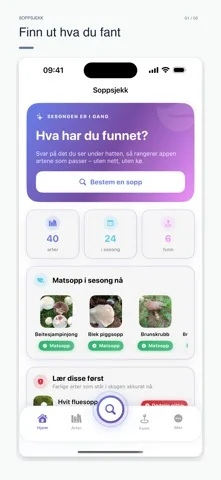

Free to download on iPhone & iPad
Frequently asked questions
Can the app tell me if a mushroom is edible?
No. It helps you compare features against species in the library. Edibility is not something to decide from an app — do not eat any mushroom you are unsure about.
Why does the base of the stem matter so much?
Several decisive features — a bulb, a sac-like sheath, a rooting base — are only visible if the mushroom is lifted whole rather than cut at ground level.