Learning German with stories is one of the most effective methods in language research — and one of the most enjoyable. Instead of memorizing isolated words, you meet vocabulary and grammar inside a context your brain actually wants to remember: characters, problems, and what happens next.
The catch is that stories only work when they match your level. A newspaper article at A2 is frustrating; a children's book at B2 is boring. That is exactly the problem graded readers — and Lesen Lab — were built to solve.
Why stories beat vocabulary lists
Research on "comprehensible input" shows that languages are acquired fastest when you understand messages that are just slightly above your current level. A story gives every new word a context, an emotion and a plot hook — three memory anchors a flashcard alone can never provide.
- Words repeat naturally: high-frequency German vocabulary appears again and again across stories.
- Grammar is absorbed in patterns: you see "weil" sentences and dative articles used correctly hundreds of times.
- Reading builds listening: following a story with audio trains your ear at the same time.
- Motivation lasts: finishing a story feels like progress, so you come back tomorrow.
The 20-minute daily story routine
- 1Pick a story at your exact CEFR level (A1–B2) — you should understand roughly 90% without help.
- 2Read it once while listening to the native audio, without stopping.
- 3Read it again, tapping unknown words for translations and saving them to flashcards.
- 4Do the quiz after the story to check comprehension.
- 5Review yesterday's flashcards for five minutes before starting today's story.

How to learn German with stories in Lesen Lab
- 1
Choose your level
Open Lesen Lab and select A1, A2, B1 or B2. Every one of the 1000+ stories is clearly labeled, so you never guess whether a text fits you.
- 2
Read with audio
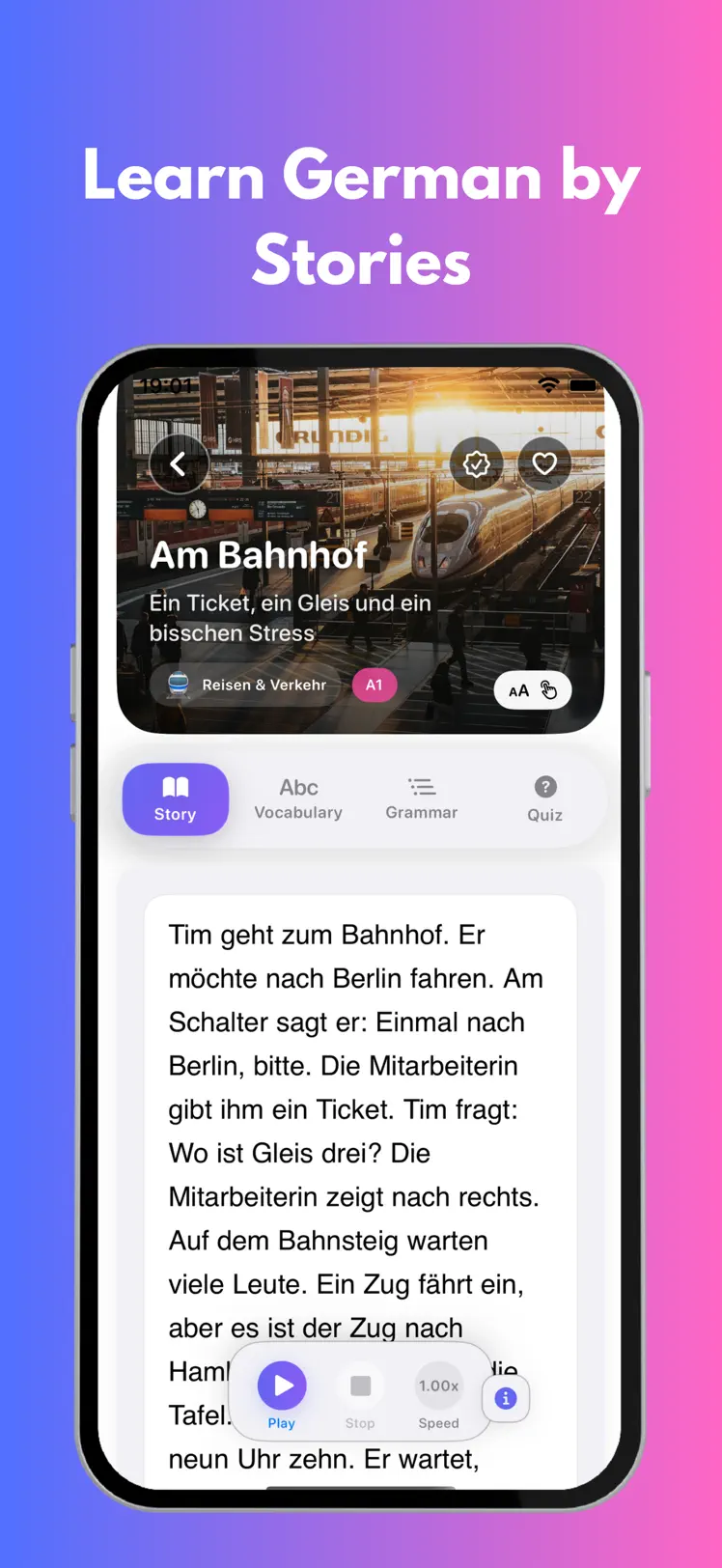
Press play and read along with native German narration. Use slow mode when the pace is too quick, and replay any sentence.
- 3
Tap to translate
Tap any word or full sentence for an instant English translation — you stay inside the story instead of switching to a dictionary.
- 4
Save words to flashcards
New words go straight into spaced-repetition flashcards, so they come back for review exactly when you are about to forget them.
- 5
Finish with the quiz
Each story ends with a short quiz on vocabulary and grammar, turning passive reading into active recall.

Free to download on iPhone & iPad
Frequently asked questions
Can a complete beginner learn German with stories?
Yes — if the stories are written for A1 level. Lesen Lab's A1 stories use short sentences, present tense and high-frequency words, with audio and instant translations so you are never stuck.
How many stories should I read per day?
One story a day (15–20 minutes) is enough for steady progress. Consistency beats bingeing: 7 short sessions a week outperform one long weekend session.
Is there an app for this kind of German reading practice?
Yes. Lesen Lab for iPhone and iPad has 1000+ graded German stories (A1–B2) with audio, translations and flashcards: https://apps.apple.com/app/id6752349330