
At a German intersection, first identify what controls the junction. Police directions, working traffic lights and priority signs take precedence over the default “traffic from the right” rule. Then consider each vehicle’s intended movement: a left turn can require waiting for oncoming traffic even on a priority road.
The best question is not “Which car is on the widest road?” It is “Which rule applies to this exact approach, and whose path would my vehicle cross?” Road width and driver confidence do not create priority.
Read the junction before reading the cars
Look beyond the vehicle positions. A small triangular yield sign, a red stop sign or a supplementary diagram beneath a priority-road sign may change the entire answer. At a bent priority road, the thick line on the diagram traces the priority road. A vehicle going straight out of it may still have to yield to a vehicle following it around the bend.
If lights are off, read the signs that remain. If no applicable sign controls the approaches, § 8 StVO normally gives priority to traffic from the right. A field or forest track joining another road is an express exception to that default rule.
Example one: a residential crossroads
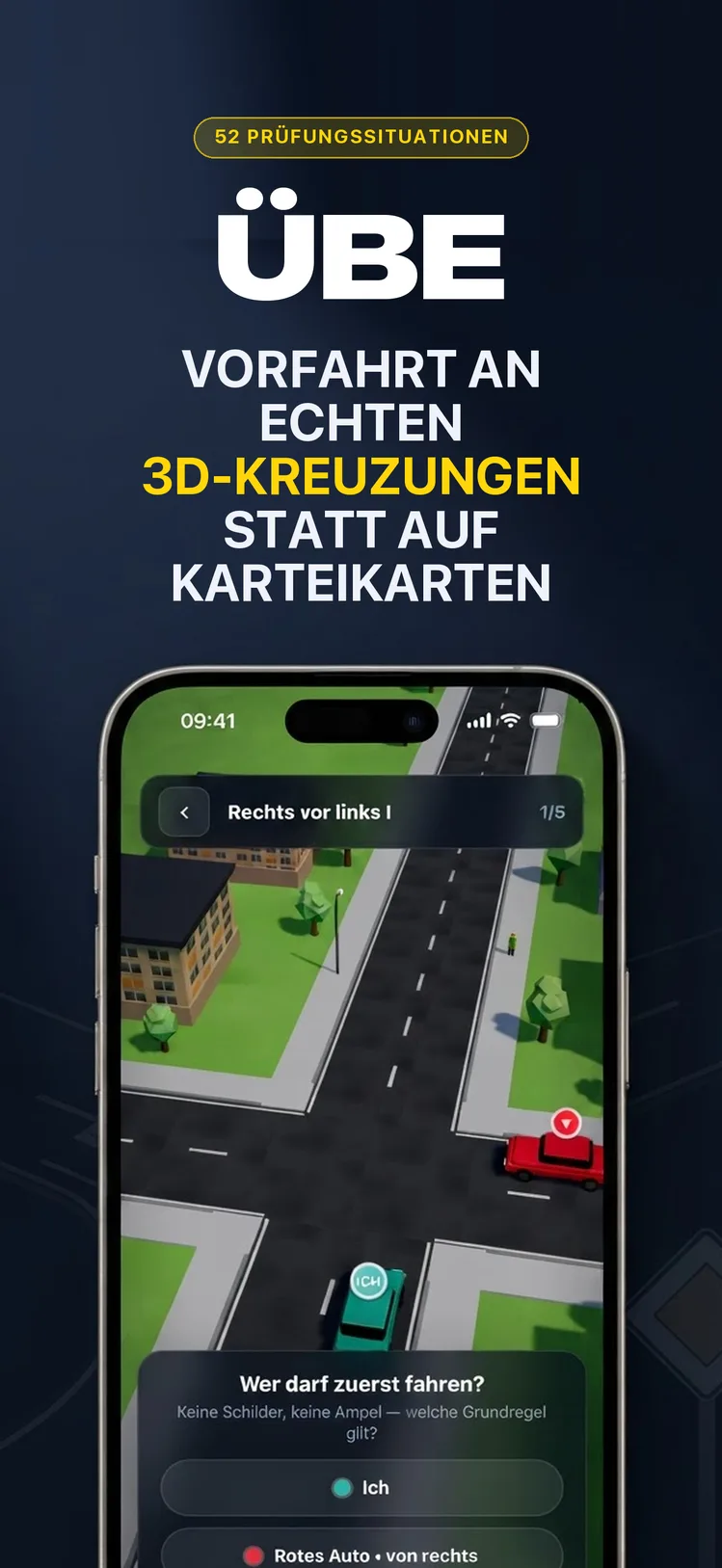
You approach an unsigned crossroads in a residential area. A car approaches from your right; another waits on your left. You yield to the car on your right. Once it has passed, reassess the car on your left and your own path. Do not assume every driver will move in a fixed queue regardless of which direction each plans to turn.
If all four approaches have vehicles and everyone has someone on the right, the drivers need clear communication and a safe voluntary waiver of priority to break the deadlock. Do not force your way through just because waiting feels awkward.
Example two: a signed priority road
You are on a road marked with the yellow diamond priority-road sign. A car from a side road wants to go straight across. You are continuing along the priority road, so the side-road car yields. Its straight movement does not outrank the signed priority road.
Now add an oncoming car on your own priority road while you want to turn left. You may need to let that oncoming car pass before completing the turn. This is why priority between roads and precedence between intersecting movements must be checked separately.
Example three: green traffic light
Your light is green and you want to turn right. A cyclist travelling straight beside you reaches the junction. You must account for that cyclist’s path under the turning rules. The signal does not erase the need to observe a cycle lane or crossing. Look ahead and to the side before steering across the line of travel.
If the light is out, do not treat your previous green phase as still valid. Slow down and re-evaluate any officer, signs and the default rule.
A repeatable decision checklist
- 1Identify the traffic controller or signal affecting your approach.
- 2Read your sign and the visible signs on other approaches.
- 3Trace the roads and intended turning paths.
- 4Apply the default right-before-left rule only where it remains relevant.
- 5Check vulnerable road users and only proceed when your full route is clear.

Turn the checklist into a habit
- 1
Pause the scene
Locate every sign and road user before deciding.
- 2
Choose the order
Name the first movement and explain the controlling rule.
- 3
Watch the result
Use the animation to compare your prediction with the safe sequence.

Free to download on iPhone & iPad
Official sources
Frequently asked questions
Is it always right-before-left in Germany?
No. That is the default at many junctions, but police directions, working lights and priority signs can control the situation first.
Does the wider road have priority?
Width alone does not establish priority. Check the applicable signs and legal rules.
What if every car has another car on its right?
Drivers must resolve the deadlock by clear, safe communication; one can visibly waive priority. Nobody should force the first move.