
German right-of-way is decided in a fixed order: police officers first, then traffic lights, then signs, and only if none of those exist the default rule “rechts vor links” (right before left). Once you know the five or six priority signs below, you can solve almost every junction you meet in Germany and in the German theory test.
The signs look similar to those in many other countries, but two catch newcomers out: the yellow diamond, which has no direct equivalent in the UK or US, and the X-triangle, which warns that you do not have priority at the next junction.
The signs that give you priority
- Priority road (sign 306, yellow diamond with white border): you have priority at every junction until it is cancelled.
- End of priority road (sign 307, yellow diamond crossed out): from here on, the normal rules apply again – often right-before-left.
- Priority at the next junction only (sign 301, red-bordered triangle with a thick black arrow and a thin crossbar): you have priority at the next junction, not beyond.
- Priority over oncoming traffic (sign 308, blue square with a white arrow and a smaller red arrow): at a narrow section you may go first.
The signs that make you wait
- Give way (sign 205, triangle pointing down): let traffic on the crossing road go first. You may roll through if it is clear.
- Stop (sign 206, red octagon “STOP”): come to a complete stop at the stop line, or where you can see if there is none – every time.
- Oncoming traffic has priority (sign 208, round with a red and a black arrow): at a narrow section you must wait for oncoming vehicles.
- Right-before-left warning (sign 102, red triangle with a black X): at the next junction, traffic from the right goes first.
The order in which rules apply
- 1Hand signals from a police officer.
- 2Traffic lights (a flashing amber light does not count – it means the light is not regulating).
- 3Priority signs such as the yellow diamond, give way and stop.
- 4Right-before-left (rechts vor links) when nothing else applies.
- 5On top of this, turning drivers must let oncoming traffic, pedestrians and cyclists pass, and emergency vehicles with blue lights and siren go before everyone.
The bending priority road
Below a yellow diamond you sometimes see an extra plate with a thick and a thin line. The thick line shows how the priority road runs through the junction – it can turn left or right. If you follow the bend, you keep priority but must indicate. If you go straight on and leave the thick line, you are leaving the priority road.

Practise German priority signs in 3D
- 1
Spot the sign
See the sign where it actually stands, from the driver’s seat.
- 2
Decide the order
Choose which vehicle goes first, second and third.
- 3
Check the explanation
Each answer comes with the StVO rule behind it.
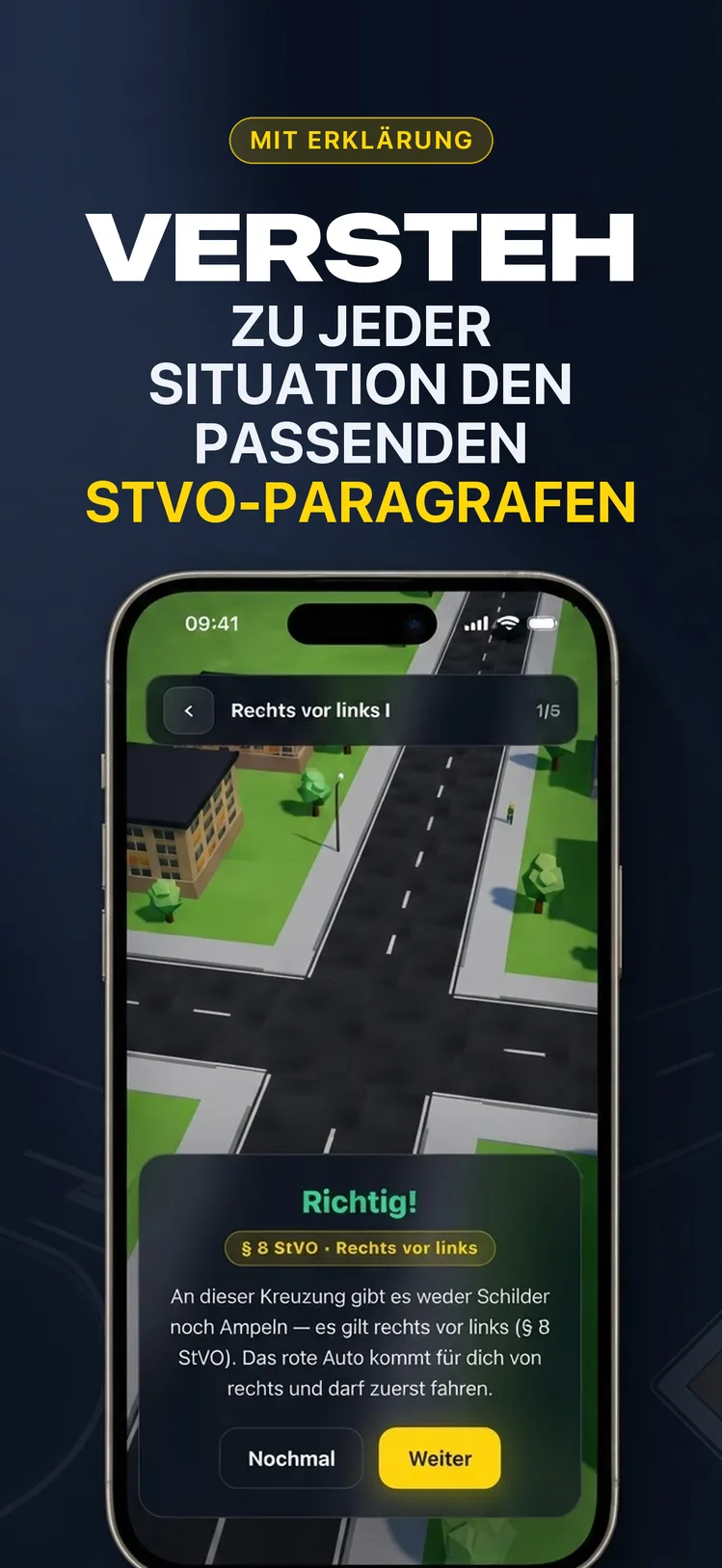

Free to download on iPhone & iPad
Official sources
Frequently asked questions
What does the yellow diamond sign mean in Germany?
It marks a priority road (Vorfahrtstraße). You have right of way at junctions until a crossed-out yellow diamond ends it.
What is the difference between give way and stop in Germany?
At give way (sign 205) you only stop if traffic is coming. At a stop sign (sign 206) you must always come to a complete stop.
What if there is no sign at a German junction?
Then right-before-left applies: traffic coming from your right goes first.
Does a traffic light override a priority sign?
Yes. Working traffic lights take precedence over signs. If the lights are off or flashing amber, the signs apply again.
Is there an app in English to practise German right-of-way?
Yes. Fahrschule 3D: Vorfahrt üben for iPhone is fully in English and German and trains German junctions in 3D: https://apps.apple.com/app/id6794609450