The easiest German books for beginners are graded readers – stories written for a specific level (A1, A2 …) with limited vocabulary. Real German books become realistic at B1, where children’s classics like Erich Kästner’s “Das doppelte Lottchen” work well, and at B2 you can read modern novels such as “Tschick”.
The rule for choosing a book: read the first page. If you need to look up more than one word in ten, put it back and choose something easier – you will learn more from three easy books than from one hard one you never finish.
A1–A2: graded readers and short stories
- Graded readers from German language publishers, usually with audio and exercises, labelled by CEFR level.
- Level-sorted short-story collections and apps where every text has a level label.
- Picture books and early readers for children – simple, but useful for everyday vocabulary.
B1: children’s classics
- “Das doppelte Lottchen” (Erich Kästner) – twins swap places; clear language and a gripping plot.
- “Emil und die Detektive” (Erich Kästner) – a boy chases a thief through Berlin.
- “Der kleine Prinz” (German translation) – familiar story, short chapters.
- “Die kleine Hexe” (Otfried Preußler) – simple, funny chapters.
B2: modern novels
- “Tschick” (Wolfgang Herrndorf) – a road trip through eastern Germany; widely read in German schools.
- “Momo” (Michael Ende) – a modern fable about time.
- “Die Welle” (Morton Rhue, German translation) – short and discussion-friendly.
How to read a German book without giving up
- 1Read a chapter for the plot first; don’t look up every word.
- 2Mark only words that appear several times or block understanding.
- 3Use the audiobook version for difficult chapters.
- 4Set a small daily goal – five pages is enough.

Build up to real books
- 1
Start with graded stories
A1 and A2 stories in Lesen Lab.
- 2
Move up a level
When a level feels easy, switch to the next.
- 3
Try a real book at B1
Your saved vocabulary makes it manageable.
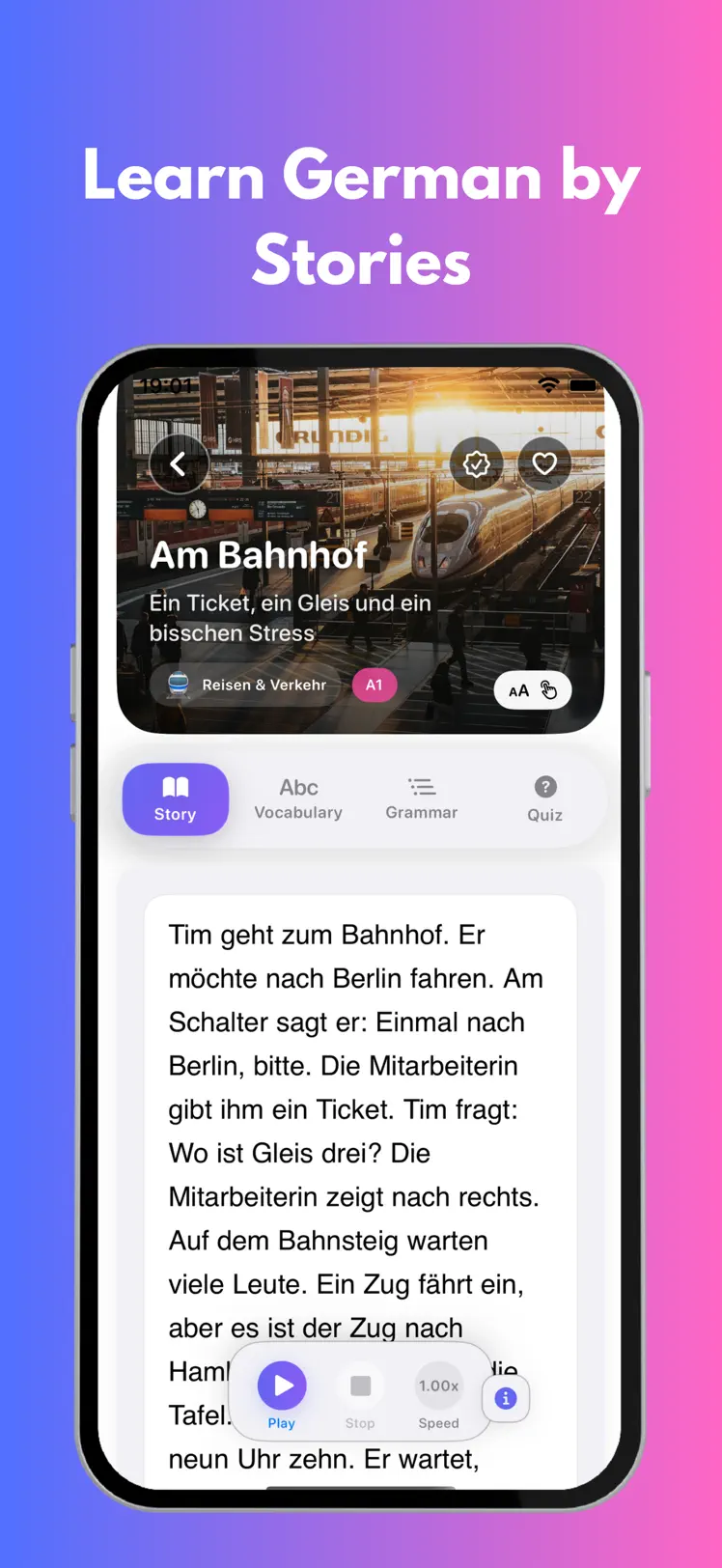

Free to download on iPhone & iPad
Official sources
Frequently asked questions
What is the easiest German book to read?
For true beginners, graded readers written for A1. Among original books, short children’s classics like “Die kleine Hexe” are relatively easy at B1.
What German book should I read at B1?
Erich Kästner’s “Das doppelte Lottchen” or “Emil und die Detektive” are popular choices for B1 learners.
Is “Tschick” good for learners?
Yes, at about B2. It uses modern colloquial German and is widely read in German schools.
Should I read German books with a dictionary?
Only for words that block understanding. Looking up every word slows you down and kills motivation.
Is there an app with easy German stories by level?
Yes. Lesen Lab: Learn German A1–B2 has 1000+ stories sorted A1–B2 with audio and translations: https://apps.apple.com/app/id6752349330