German language levels use the six-step CEFR scale. A1 means you can handle very basic everyday phrases, A2 simple routine situations, B1 most situations while travelling or living in Germany, and B2 fluent conversation with native speakers on many topics. Each level builds on the previous one.
According to the Goethe-Institut, reaching A1 takes roughly 60–150 hours of instruction, A2 about 150–260, B1 about 260–490 and B2 about 450–600 hours in total. Your own time depends on your native language, other languages you know and how much you practise outside class.
What you can do at each level
- A1: introduce yourself, ask and answer simple questions about where you live and people you know, understand slow, clear speech.
- A2: talk about your background and immediate needs, handle shopping, the doctor or the bank in simple sentences, read short everyday texts.
- B1: understand the main points of clear standard speech on familiar topics, deal with most situations when travelling, write simple connected texts and give reasons for opinions.
- B2: understand the main ideas of complex texts, talk spontaneously with native speakers without strain, write clear detailed texts.
Which level do you need?
- Spouse visa: usually A1.
- Permanent settlement permit and citizenship: B1 (Goethe, telc or the DTZ from the integration course).
- Nursing and many healthcare jobs: often B1 or B2 depending on the federal state and profession.
- German-taught university degrees: usually C1 (TestDaF, DSH, Goethe C1).
How to find your current level
- 1Take a free online placement test from a language school or the Goethe-Institut.
- 2Download an official model test for the level you think you have and do it under exam conditions.
- 3Read a graded text at that level: if you understand the main points and need fewer than one in ten words translated, the level fits.
- 4Ask a teacher to rate a short text you have written.

Find your reading level in Lesen Lab
- 1
Try one story per level
Start at A1 and move up.
- 2
Count unknown words
More than one in ten? Stay one level lower.
- 3
Take the quiz
Check comprehension after each text.

Free to download on iPhone & iPad
Official sources
Frequently asked questions
What does German A1 mean?
A1 is the first CEFR level: you can understand and use very basic expressions, introduce yourself and ask simple questions.
Is B1 German good?
B1 means you are an independent user: you can handle most everyday situations and write simple connected texts. It is the level required for German citizenship.
How long does it take to go from A1 to B1?
The Goethe-Institut estimates about 260–490 hours of instruction in total to reach B1 from zero, so A1 to B1 is roughly 200–350 additional hours.
How can I test my German level for free?
Use a free online placement test or an official model exam, and read graded texts at different levels.
Which app has German texts sorted by level?
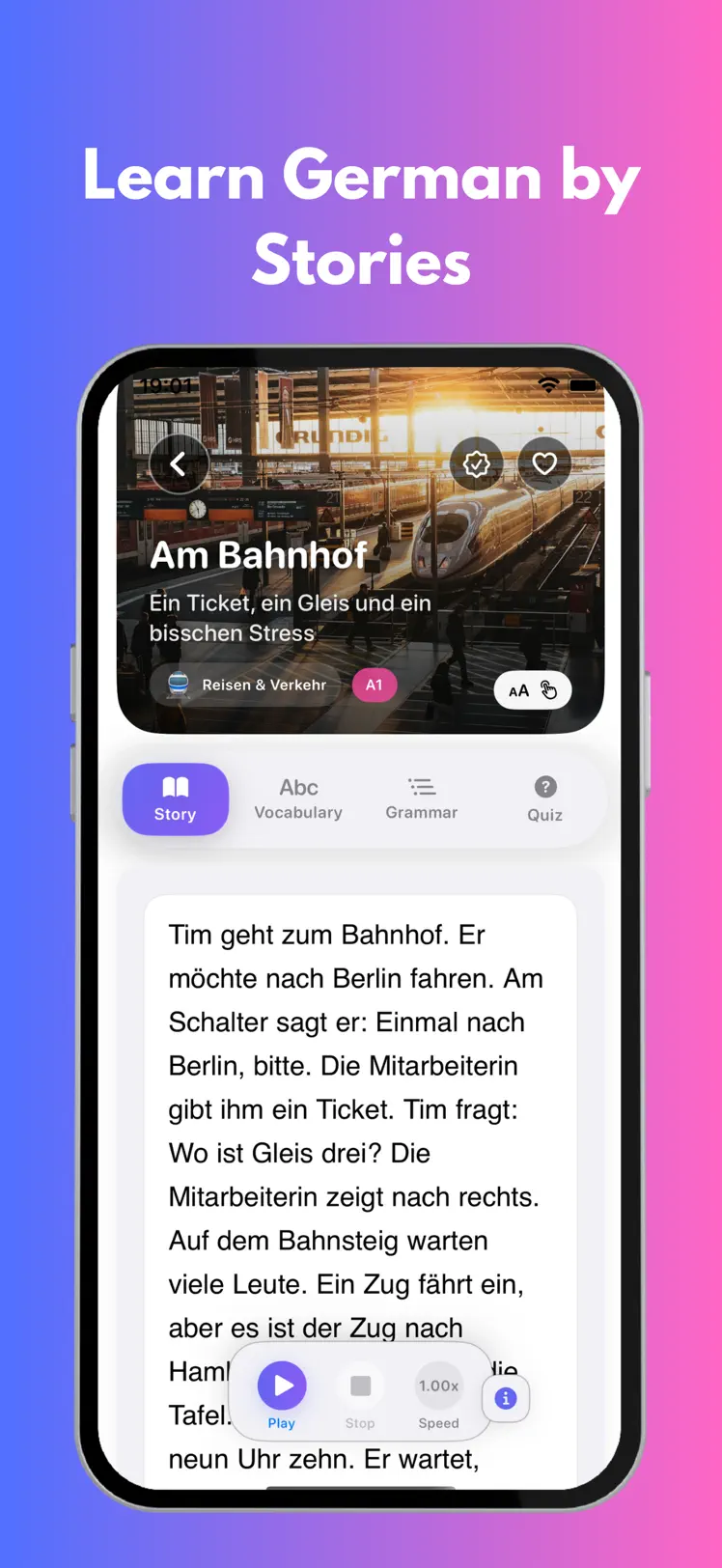
Lesen Lab: Learn German A1–B2 sorts 1000+ German stories by CEFR level from A1 to B2: https://apps.apple.com/app/id6752349330