There are two proven pillars of vocabulary learning: context (meeting words inside real sentences) and spaced repetition (reviewing them at growing intervals just before you forget). Most learners use one or the other. The learners who progress fastest use both, connected.
That connection is the trick: words you save while reading a story carry their context with them — and context is what makes a flashcard reviewable years later.
Why word lists fail
A list of 50 translated words gives your memory nothing to grip: no sentence, no situation, no emotion. Research consistently shows contextualized vocabulary outperforms isolated lists on long-term retention — often by a factor of two or more. If you have ever "learned" a list on Monday and lost it by Friday, you have felt this.
The spaced repetition effect
Your brain strengthens a memory most when it retrieves it just before forgetting. Spaced-repetition systems (SRS) schedule each word's reviews at exactly those moments — typically after 1 day, 3 days, 1 week, 1 month. Ten minutes of SRS review daily maintains thousands of words.
- New words come back the next day, while still fresh.
- Known words wait longer, so you never waste reviews.
- Struggling words repeat sooner, automatically.
The daily vocabulary routine (20 minutes)
- 1Read one graded story and tap-save every genuinely useful unknown word (5–10 per story is ideal).
- 2Review today's due flashcards — the app schedules them, you just answer.
- 3Take the story quiz to retrieve the new words one extra time in context.

How Lesen Lab combines stories and flashcards
- 1
Save words as you read
Tap any word in a story for the translation, and save it to your flashcard deck in the same tap.
- 2
Review with spaced repetition
Lesen Lab schedules each card's reviews automatically, so words return exactly when your memory needs them.
- 3
Reinforce with quizzes
After-story quizzes retrieve new vocabulary in context — a second memory pathway on top of the flashcards.
- 4
Watch your word count grow
Track saved and mastered words by level as your active German vocabulary compounds week after week.
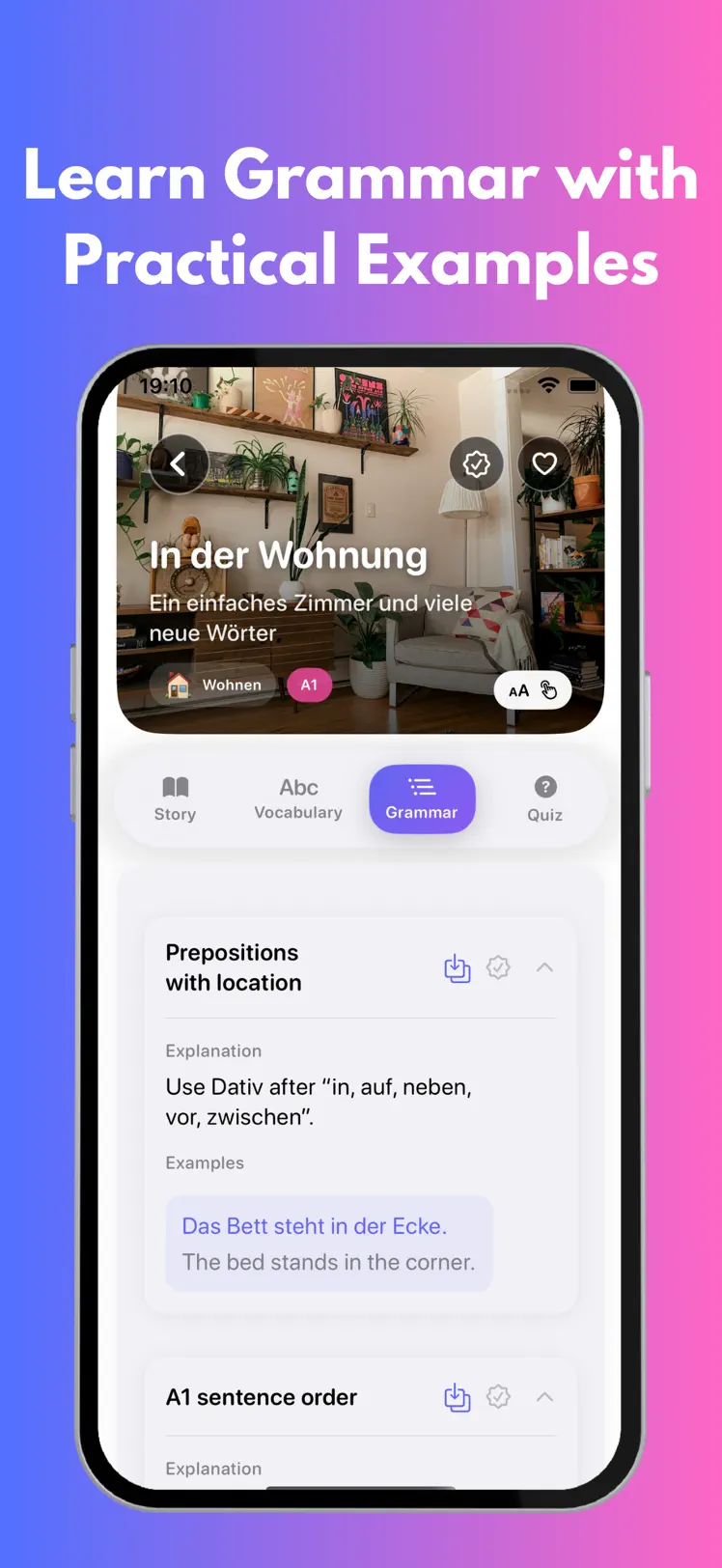

Free to download on iPhone & iPad
Frequently asked questions
How many German words should I learn per day?
Five to ten new words daily from your reading is sustainable and compounds to 2000–3500 words a year — enough to reach B1–B2 comprehension.
Are Lesen Lab flashcards unlimited?
The free version includes flashcards to get started; Lesen Lab PRO unlocks unlimited flashcards plus the full review mode.
Is there an app for this kind of German reading practice?
Yes. Lesen Lab for iPhone and iPad has 1000+ graded German stories (A1–B2) with audio, translations and flashcards: https://apps.apple.com/app/id6752349330