
For a first German Class B car licence, the usual route is to enrol at a driving school, apply to the local driver licensing authority, complete the required training, and pass both a theory and a practical test. The authority checks your documents and eligibility; your driving school organises instruction and helps prepare you for the examinations.
This guide is for a first licence. If you already hold a licence issued abroad, the procedure may be different. Ask your local Fahrerlaubnisbehörde which rules apply to your country of issue before paying for a full training package.
1. Choose a driving school and prepare the application
Compare schools on teaching language, lesson availability, total price structure and how they schedule tests. You will normally need proof of identity, a biometric photo, an eyesight test and proof of first aid training for the application. Your local authority may request additional documents, so use its own checklist rather than a generic internet list.
Submit the application early enough that administrative processing does not delay your test. A driving school can explain the local workflow, but the licence is issued by the competent authority, not by the school or a practice app.
2. Study theory and take driving lessons
German training has general theory lessons and Class B specific lessons. The training regulation sets minimum theory units; it also provides special practical drives such as rural road, motorway and darkness training. Your instructor decides with you when your driving is sufficiently safe and consistent for a test, beyond any statutory minimum.
Treat priority, signs, turning and hazard perception as connected topics. Learning a question bank by memory can fail when an intersection is rotated or an extra cyclist is added. Practise explaining why one road user may go first, not just which answer box to tick.
3. Pass the theory test
The German theory test checks legal rules, hazards and safe driving knowledge. It can be taken in English and several other listed languages under the Fahrerlaubnis-Verordnung. The exact question format and assessment are governed by the current examination rules, so confirm the test language and booking with your school before the appointment.
For right-of-way questions, use a repeatable method: look for police direction, traffic lights and priority signs; only then consider the default priority rule. After that, check turning movements, cyclists and pedestrians. This method is more reliable than deciding from the width of the road.
4. Prepare for the practical test
During driving lessons, practise the same decisions in real traffic: approach speed, observation, indicating, position and safe gaps. At an intersection, identify the controlling signal early and say to yourself which road users could cross your path. Your instructor will help you judge when you can do that consistently without prompting.
The practical test assesses safe control of the vehicle and application of the rules in traffic. A phone exercise can help you understand priority, but it cannot replace supervised driving or teach the physical observation routine on its own.
Where a 3D practice app can help
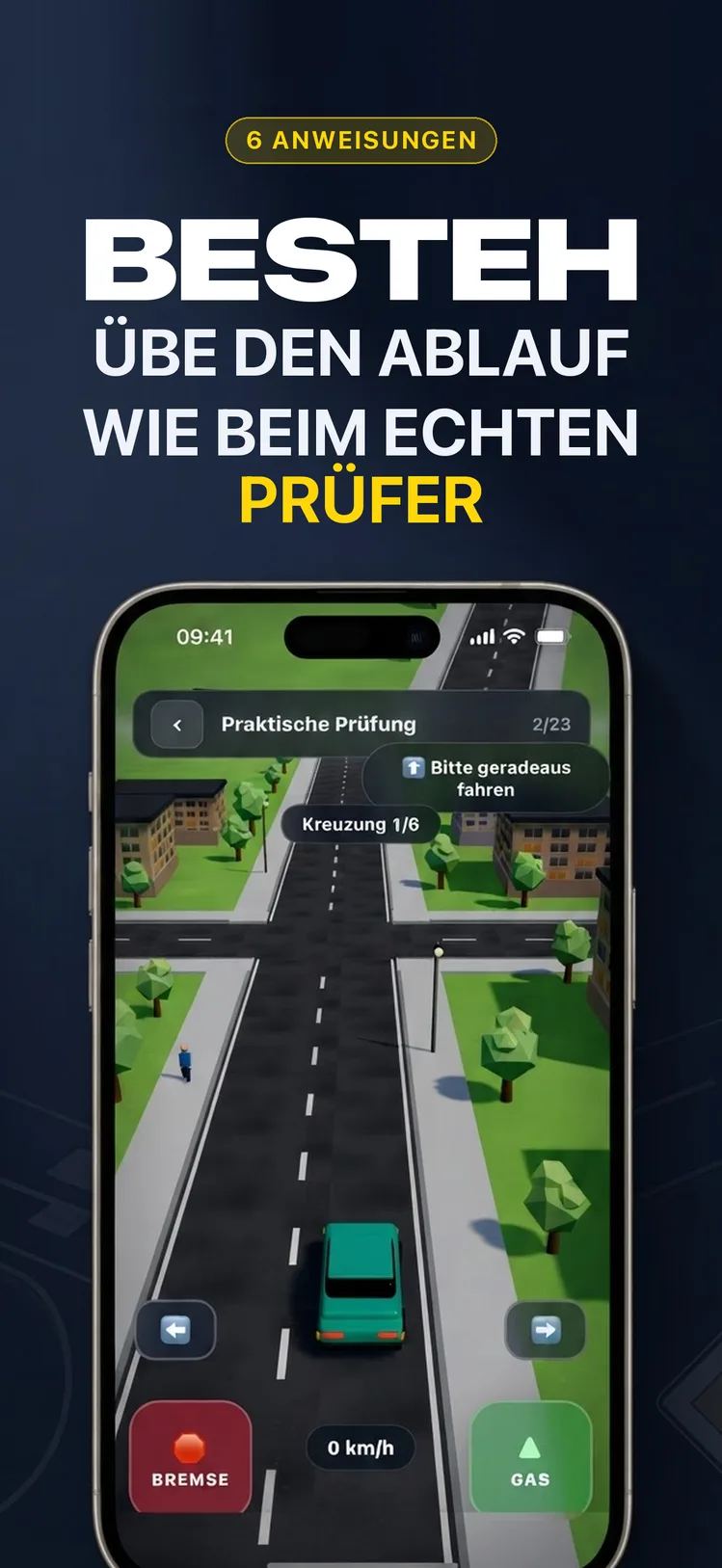
Fahrschule 3D: Vorfahrt üben focuses on intersection and priority decisions. It presents a junction from the driver’s viewpoint, asks who goes first, then shows the movement and explanation. Use that kind of practice between lessons when you repeatedly hesitate at right-before-left junctions, signs or turning conflicts.
Keep a short error log: Which sign did you miss? Was the other vehicle on the priority road? Did a pedestrian or cyclist change the answer? Bring those patterns to your next driving lesson. That connects digital practice with the decisions you must make on the road.

Use junction practice between lessons
- 1
Choose one priority topic
Start with right-before-left, signs or a turning conflict.
- 2
Predict the order
Explain who goes first before viewing the animation.
- 3
Discuss mistakes
Take unclear examples to your driving instructor.

Free to download on iPhone & iPad
Official sources
Frequently asked questions
Can I take the German theory test in English?
Yes. English is one of the permitted theory test languages listed in Annex 7 of the Fahrerlaubnis-Verordnung. Confirm the language when booking.
Do I need a first aid course and eyesight test?
These are normally part of a first Class B application. Check the exact document list with your local licensing authority.
Can a practice app replace a driving school?
No. The app is a supplement for understanding junction decisions; formal training and the official tests remain part of the licence process.
Does this guide apply when exchanging a foreign licence?
Not necessarily. Exchange and recognition depend on the issuing country and your circumstances. Ask the local driver licensing authority for the relevant procedure.