A Werkstudent position — up to 20 hours a week during the semester, in a real company, on a real project — is the most common first job for international students in Germany and often the path to the job after graduation. Companies hiring Werkstudenten know you are a student with limited experience. What they filter on is whether you understand the German application format and whether you fit the hours they need.
Your CV has to answer both in the first ten seconds.
Format: the German expectations
- One page for a student, two at most. Reverse chronological, dates on the left in month/year format, no gaps unexplained.
- A short header with name, city, phone, email and a link to LinkedIn or GitHub. A photo is optional in Germany and increasingly omitted; if you include one, make it a professional headshot.
- Sections in this order: education, then experience, then skills and languages. For a student the degree comes first because it is the reason you qualify for the role at all.
- Save as PDF, named with your surname and the role. Never a Word file.
What to put when experience is thin
- University projects with a concrete result: the tool you built, the dataset you analysed, the grade if it was strong.
- Relevant coursework listed by module name, not just the degree title — a recruiter for a data role wants to see statistics and databases on the page.
- Internships, part-time and volunteer work from home, with the tasks framed in the language of the target role.
- Tools and languages with honest levels: Python (advanced), SQL (working), German (B1, certificate date). Overstating German is the most common and most quickly discovered exaggeration.
The details that get you filtered out
- No mention of availability. State your semester dates and the hours you can work — companies plan around the 20-hour rule and the full-time option in semester breaks.
- No enrolment status. Werkstudent status depends on being an enrolled full-time student; say it explicitly.
- A generic CV sent to twenty companies. Reorder skills and projects for each posting; it takes five minutes and is visible immediately.
- Missing residence and work permission. One line — for example, residence permit for study with 140 full days of work permitted — removes a question the recruiter would otherwise have to ask.
Pair it with a short cover letter
German companies still read cover letters for Werkstudent roles, and a short one — three paragraphs, why this company, why this role, when you can start — is enough. It is also the place to address anything the CV cannot: a career change, a gap, why a mechanical engineer is applying to a marketing team.
Keep both documents in the same visual style and the same language as the job posting. A German-language posting gets German documents, even if the interview turns out to be in English.

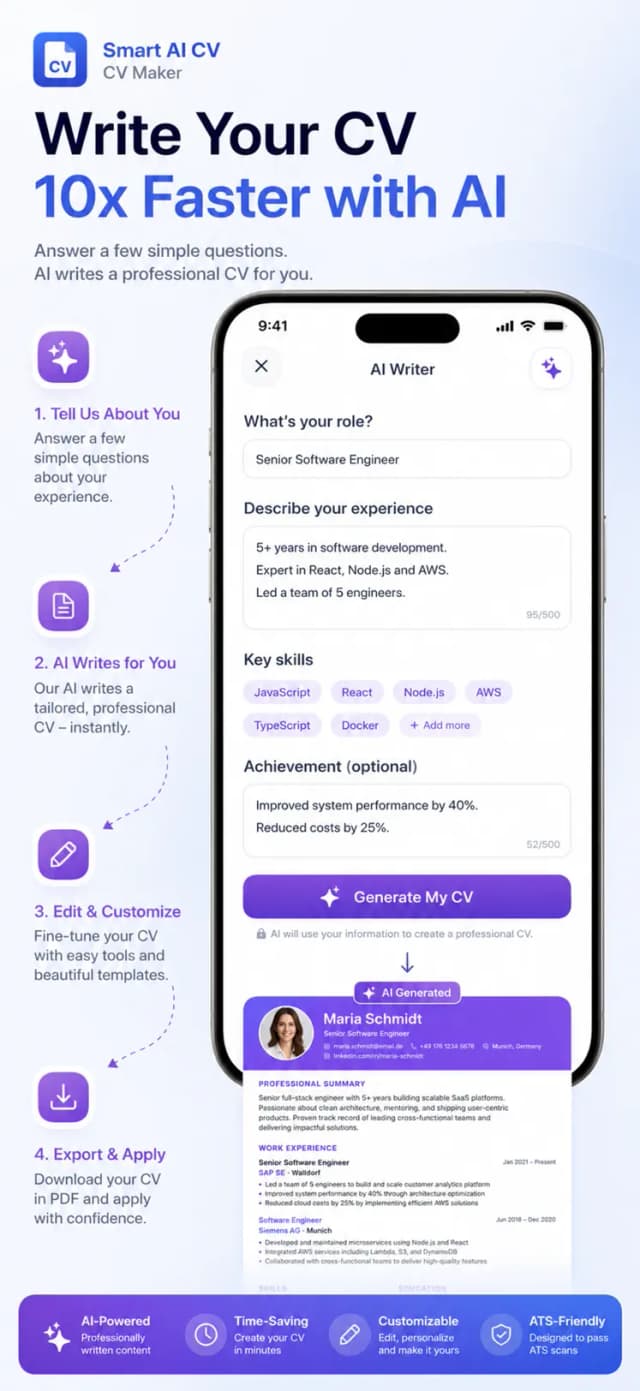
Building the Werkstudent CV in the app
- 1
Pick a German template
The Lebenslauf layouts put education first and dates on the left, as German recruiters expect.
- 2
Add projects as experience
Each university project gets a title, date range and two result-focused bullet points.
- 3
State availability
A dedicated line for hours per week and semester dates sits near the top.
- 4
Export per application
Duplicate, reorder the skills for the posting, export a PDF named for that company.

Free to download on iPhone & iPad
Frequently asked questions
Do I need a photo on a German CV?
No. It was traditional and is now optional; many companies explicitly prefer applications without one. If you include a photo, it should be a proper headshot, not a cropped social-media picture.
Should the CV be in German or English?
Match the job posting. A posting written in German expects German documents. If your German is below B2, write it in English and state your German level honestly rather than submitting a machine-translated Lebenslauf.