If you are applying for a job, apprenticeship or university place in Germany, your resume needs to become a Lebenslauf — and the differences are more than translation. German recruiters expect a specific tabular format, different personal details, and conventions (like signing your CV) that surprise international applicants.
Getting the format right signals cultural fluency before anyone reads a word about your qualifications.
How a Lebenslauf differs from a US/UK resume
- Tabular format: two clean columns — dates left, details right — in strict reverse-chronological order.
- Personal details block: full name, address, phone, email, date and place of birth are customary (though anti-discrimination law makes some optional).
- Photo: a professional headshot remains common and often expected in practice, though legally optional.
- Length: 1–2 pages is normal; two pages are fine for experienced candidates.
- Signature: traditionally you date and sign the Lebenslauf at the bottom — a formality German recruiters notice.
- No gaps: German recruiters expect a complete timeline; explain gaps briefly rather than hiding them.
The standard structure
- 1Persönliche Daten — personal details (with optional photo top right).
- 2Berufserfahrung — work experience, reverse-chronological with month/year dates.
- 3Ausbildung / Studium — education, including your degree grade if good.
- 4Kenntnisse — skills: languages with CEFR levels (B2, C1), software, driving license.
- 5Optional: Weiterbildung (training), Ehrenamt (volunteering), Interessen.
- 6Ort, Datum, Unterschrift — place, date, signature.
Language levels: use CEFR
German employers expect language skills stated in CEFR levels — "Deutsch: B2, Englisch: C1" — not vague words like "fluent". If you hold a Goethe, telc or TestDaF certificate, name it: certified levels carry real weight, especially for international applicants.

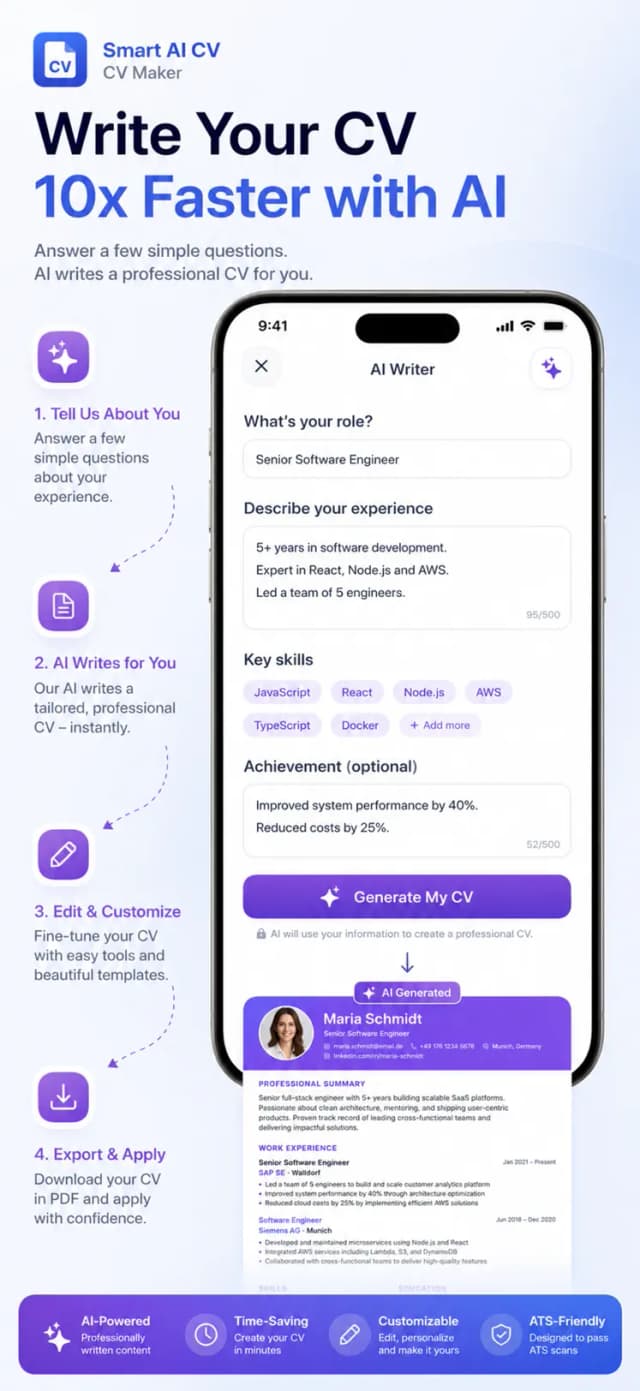
Creating a German-style CV with CV Maker
- 1
Choose a tabular template
Pick a clean two-column template matching the German convention — dates left, content right.
- 2
Add the German details block
Include the personal information German recruiters expect, with an optional professional photo.
- 3
State languages in CEFR
List each language with its level (B1, B2, C1) and certificates — the format German HR reads instantly.
- 4
Export, date and sign
Export the PDF, add place and date, sign it — and your Bewerbung is ready to send.

Free to download on iPhone & iPad
Frequently asked questions
Is a photo required on a German CV?
Legally no — anti-discrimination law makes it optional. In practice, a professional headshot is still common and many applicants include one.
Should the Lebenslauf be in German or English?
Match the job ad's language. German-language postings expect a German Lebenslauf; international companies posting in English accept English CVs — ideally still in the German tabular format.