A surprising number of German master's programmes, and uni-assist itself for some, require a CV alongside the transcripts and motivation letter. Applicants often submit the job CV they already have. Admissions committees are not hiring; they are checking academic background, continuity and fit, and the document that serves them is different.
Germany has a name for it: the tabellarischer Lebenslauf — a tabular, chronological, unembellished account of your education and relevant experience.
What admissions committees read it for
- Continuity: are there gaps between school, bachelor and now, and are they explained? A gap year is fine; an unexplained gap is a question.
- Academic depth: which modules, thesis topic, research projects, publications or lab work — the substance behind the transcript.
- Relevance: does the bachelor connect to the master you are applying for, and if not, what bridges the two?
- Language and international exposure: certificates with levels and dates, exchange semesters, work in other countries.
Structure of the tabular Lebenslauf
- 1Personal data: name, date and place of birth (still conventional in the academic version), nationality, contact details.
- 2Education, reverse chronological: degree, institution, dates, final grade or GPA converted to the German scale, thesis title. School-leaving qualification with grade.
- 3Academic experience: research assistant roles, lab work, tutoring, publications, conference posters.
- 4Professional experience relevant to the field, briefly.
- 5Languages with certificates and levels; IT and methods skills relevant to the subject.
- 6Awards, scholarships, memberships.
- 7Place, date and signature at the bottom — the one place a German document is still expected to carry a signature.
How it differs from a job CV
- No profile summary or career objective. The motivation letter does that work.
- Thesis titles and grades are included; in a job CV they are usually dropped.
- Extracurricular and volunteer work only where it shows something academically relevant — leadership, organisation, the field itself.
- Two pages are acceptable for a master's applicant with research experience; one is enough for most.
Details that cost applications
- Grades in a foreign scale with no conversion. Add the German equivalent in brackets — the committee will convert it anyway, and doing it for them shows you understand the system.
- Dates that do not match the transcripts. Committees cross-check.
- A CV in a different language from the rest of the application.
- Decorative templates. The academic Lebenslauf is plain by convention; design effort reads as the wrong kind of effort.

Producing the academic Lebenslauf in the app
- 1
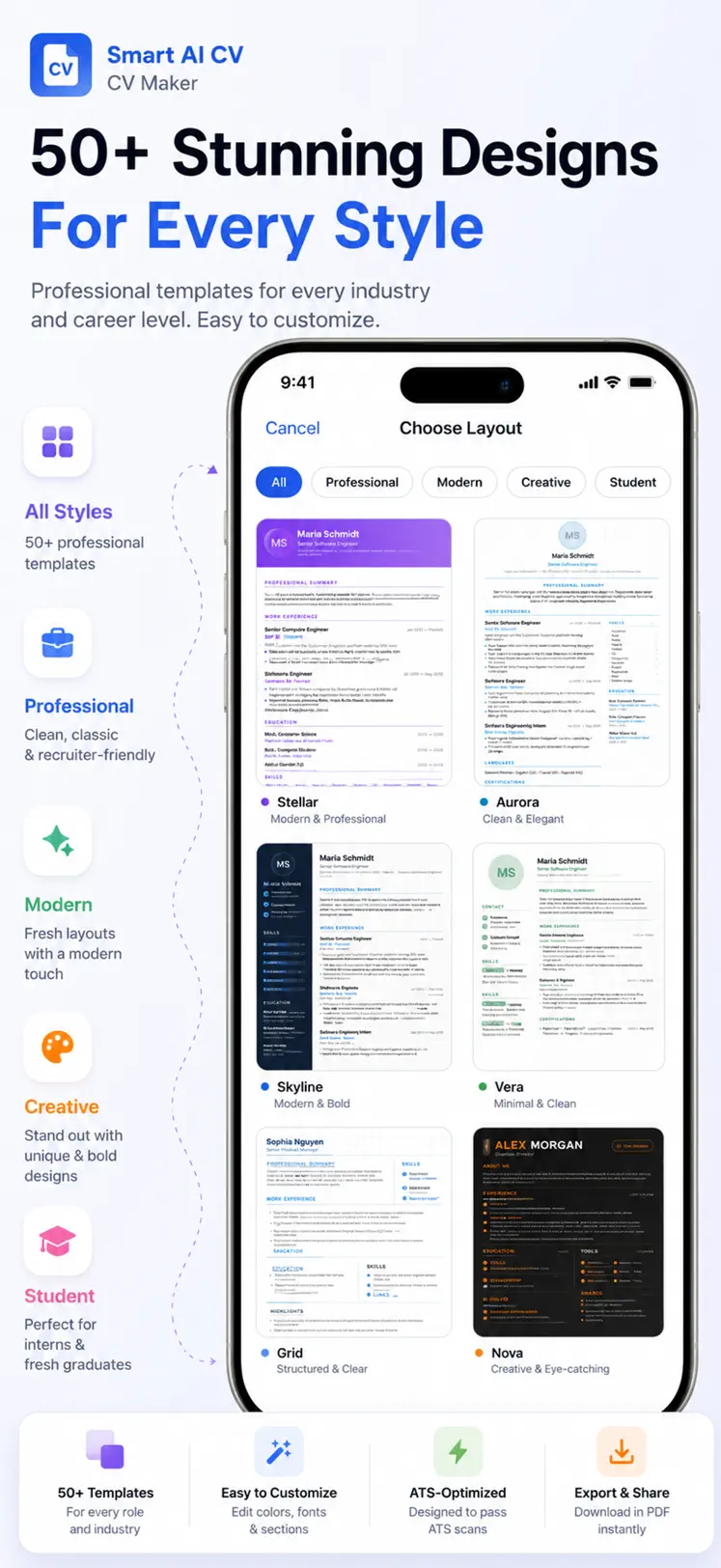
Choose the classic layout
The tabular templates put dates left and content right, with no summary block.
- 2
Enter degrees with detail
Thesis title, grade and key modules each have their own field.
- 3
Add converted grades
Use the GPA converter to state your grade on the German scale alongside the original.
- 4
Export and sign
PDF with a signature line, named for the programme you are sending it to.

Free to download on iPhone & iPad
Frequently asked questions
Do I need a photo on an academic CV?
No. It is optional and admissions committees do not expect one. Leave it off unless the programme explicitly asks.
Should I convert my grades to the German scale?
Yes, in brackets next to the original. Use the Modified Bavarian Formula and state the scale you converted from, so the committee can see your working.