The accelerometers in a modern phone are good enough that a software spirit level is genuinely useful for household work. What throws it off is almost never the sensor: it is the case, an uneven back, or a calibration done on a surface that was not level.
Ten seconds of checking removes most of the doubt.
The ten-second check
- 1Place the phone on a surface and note the reading.
- 2Rotate it 180 degrees in place and read again.
- 3If both readings agree, the level is calibrated — the surface may be sloped but the tool is honest.
- 4If they differ, the offset between them is your calibration error; recalibrate and repeat.
What affects the reading
- A thick or uneven case, especially with a camera bump lifting one end.
- Calibrating on a surface you assumed was level but was not.
- Measuring on a soft or flexible surface that gives under the weight of the phone.
- Temperature swings, which is why a re-check before precise work is worthwhile.
Jobs it handles well
- Hanging pictures, mirrors and shelves.
- Levelling a washing machine or fridge.
- Checking whether a floor or worktop slopes, and by how much.
- Setting an angle with the inclinometer — a ramp, a drainage fall, a ladder.

Using the level in Mitta
- 1
Take the case off
Or at least check with and without it — most calibration error lives in the case.
- 2
Calibrate on a known surface
Then verify with the 180-degree rotation check.
- 3
Use edge mode for verticals
The edge of the phone against a door frame or shelf upright.
- 4
Switch to the protractor for angles
For anything that needs a specific degree rather than plumb or level.
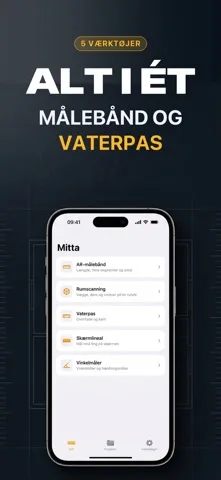

Free to download on iPhone & iPad
Frequently asked questions
Is a phone level as good as a real one?
For household jobs, close enough once calibrated. For structural work or long spans, a proper spirit level is still the right tool.
Why is the screen ruler calibrated with a card?
Payment cards are a standardised size worldwide, so they make a reliable reference for scaling the on-screen ruler to your particular display.