

A useful German driving theory test cheat sheet should help you explain a decision when the picture changes. Remembering that “the blue car goes first” will not help when the next question moves the sign, adds a cyclist or changes your turn.
Use the checklist below to work through German junction questions. It covers priority decisions rather than the entire theory syllabus. Keep studying with current exam materials from your driving school, then use unfamiliar examples to check your understanding.
The five checks
1. Is someone directing traffic?
Follow a police officer’s directions at the junction. Do not choose a movement merely because a signal behind the officer is green. You still have to proceed carefully. StVO § 36.
2. Which signal controls my movement?
Find the light that applies to your lane and direction. Ordinary green allows movement under the turning rules; it does not make every turn conflict-free. A dark signal is not permission to drive through without checking the junction. StVO § 37.
3. What do the signs require?
Read the sign on your approach and any supplementary panel. At a stop sign, stop and yield. At a give-way sign, yield; stopping depends on what is needed to do that safely. A thick line on a supplementary panel can show the course of a priority road. StVO, Annex 2 — signs 205 and 206.
4. What kind of road or exit is this?
At an ordinary junction without a higher controlling rule, check for traffic from the right. First make sure you are looking at a normal road junction: a driveway or an entry across a lowered kerb has its own duties. Do not decide from road width or vehicle size. StVO § 8, StVO § 10.
5. Whose path will I cross?
Trace your turn through the whole junction. Look for oncoming vehicles and for pedestrians or cyclists crossing your turning path. Finally, check that you can leave the junction without blocking it. StVO § 9, StVO § 11.
Copy or print this checklist
Use your browser’s Print command to print the page, or copy these prompts into your study notes. The label “cheat sheet” means a revision aid to use before the test.
- ☐ Control: officer, applicable signal, then priority signs.
- ☐ Layout: normal junction, driveway, lowered kerb or another special entry?
- ☐ Direction: where is each road user coming from and going?
- ☐ Conflict: which paths cross mine, including oncoming and crossing traffic?
- ☐ Space: can I finish the movement without blocking anyone?
- ☐ Reason: can I name the cue that makes this answer correct?
Helpful German words: Vorfahrt gewähren means give way; Rechts vor links refers to priority from the right; Gegenverkehr means oncoming traffic; Abbiegen means turning.
For more detail, keep the existing English priority-sign guide alongside this checklist.
Three quick practice questions
A. You want to turn left at an ordinary green light. A car opposite has green and is travelling straight. There is no separate arrow signal.
Let the oncoming car pass before crossing its path. Then check the road you are entering for other road users. Finding a green light completes only part of the decision.
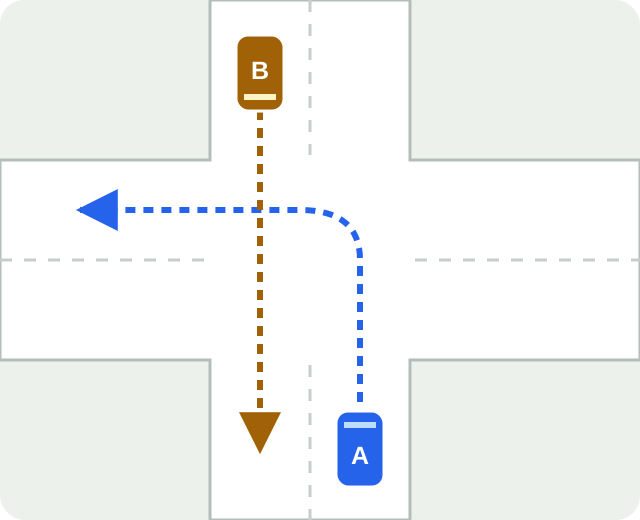
B. You are on an ordinary unsigned road junction. The only other car approaches from your right. Both of you want to continue straight.
Let that car go first. Now change the scene: it is entering from a driveway instead. The fact that it is on your right no longer gives the answer by itself. Identify the type of entry before applying the default rule.
C. Your route has priority, but a queue would leave your car standing across the junction.
Wait before entering. “I have priority” does not answer whether there is room to complete the movement.
Turn mistakes into the next exercise
Write one sentence after an error: “I missed the lowered kerb” or “I checked the cars but not the turning path.” Then find a different example with that cue. This gives your next study session a specific task.
For a fuller study method, read German theory-test priority questions in English. For crossing situations, see the English pedestrian-crossing guide.
Try the checklist in Vorfahrt 3D for iPhone and iPad. Choose English, inspect a junction from the driver’s viewpoint and explain your decision before revealing the animated answer. The first exercises are free; full access requires an in-app purchase.
